
File Renamer

A batch of files.
Names that make sense.

Build a set of naming rules, check every proposed change, and rename your files in one deliberate step.

Stable · 2.0.5Free · Windows & Linux · x64
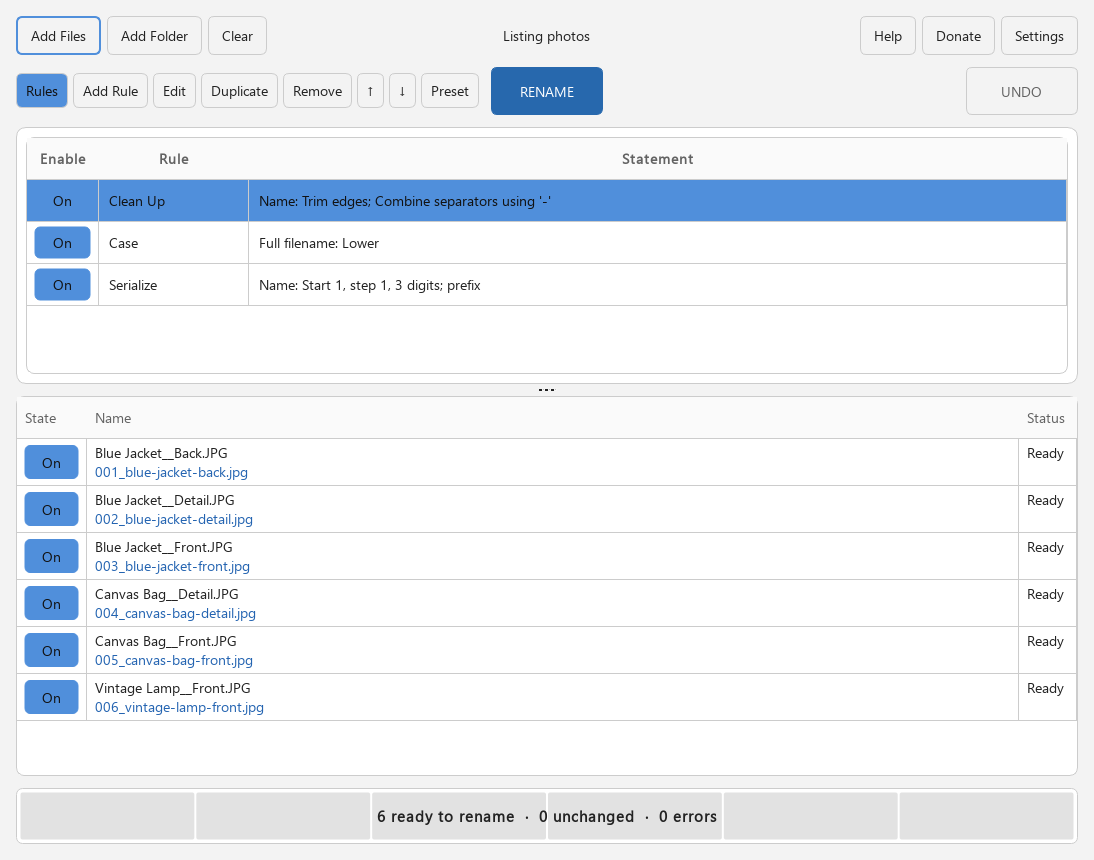
File Renamer showing three ordered rules and six synthetic listing filenames, with each proposed name below its original.
Actual source-build app interface with synthetic listing filenames. Original and proposed names are shown together; no personal files are pictured.

One job, made clearer

A folder that makes sense.

Combine text cleanup, case, and numbering rules. Save the rules as a preset for the next batch, and inspect the proposed names before renaming.

Illustrative naming pattern

OriginalIMG_0042.JPG
Proposedceramic-mug-001.jpg

Names change. File contents and locations stay the same.

A clear path to the result

Preview first. Rename second.

A preview-first batch renamer for local files. Combine ordered rules, review original and proposed names together, and undo the most recent batch when needed.

  1. Choose the files.

    Add files, add a folder, or drag them in. Files stay in their existing folders. Exclude anything that should not change.

  2. Build and check the rules.

    Rules run from top to bottom. Review the original and proposed name for each file, and fix or exclude any errors before continuing.

  3. Rename with a recovery path.

    Rename applies the previewed names. The app keeps a recovery journal and can undo the most recent batch, including after a restart. Keep backups of important files.

The practical details

What it does.

Workflow
Ordered rules with original/new filename preview
Rules
Text cleanup, case, numbering, replacement, dates, metadata, and more
Presets
Save, load, import, and export reusable rule sets
Recovery
Persistent last-batch Undo and interrupted-batch recovery
Processing
Local and offline; file contents are not changed

Know before you start

Keep the limits in view.

  • Names change on disk. Back up important files and test a small batch first.
  • Files stay in the same folder. This is not a tool for moving files or renaming directories.
  • Hidden files, hidden folders, symbolic links, and Windows junctions are skipped. Subfolder scanning is an explicit setting.
  • Undo covers only the most recent batch; starting another batch replaces that history. External file changes can prevent recovery.
  • A batch is a sequence of filesystem operations, not one filesystem-wide atomic transaction. Do not edit or move its files while it runs.
  • Linux filesystems must support no-replace renames. Unsupported filesystems fail rather than overwrite a destination. No macOS package is provided.

Get File Renamer

A small tool.
Ready when you are.

Every feature is free. Donations are optional and do not unlock features. Choose a package for your computer and read its setup notes.

Stable 2.0.5. Unsigned x64 packages. Python is bundled. Linux is available as an AppImage or a portable tar.gz. No macOS package is provided.

Windows

Portable ZIP · x64

  1. Download the ZIP and compare its SHA-256 below.
  2. Extract the entire ZIP, then open File-Renamer/File-Renamer.exe. Keep _internal and the other bundled files beside it.
  3. Python is bundled. Test naming rules on a small backed-up sample before renaming important files.

This package is unsigned. Windows may show a SmartScreen warning. Do not bypass a warning for an unexpected download, mismatched checksum or source you do not trust.

Release checks
  • Automated release and packaged workflow checks passed for this exact Windows x64 ZIP.
  • Interactive Windows desktop acceptance has not been recorded for this package.
  • Wider hardware, display and assistive-technology coverage remains unverified.
Download for Windows

SHA-256
d2a1524e0ed8bcd76e9a555861a888fb0e396b57fce7059c2b0e29450a029f09

Linux

AppImage · x64

  1. Download the AppImage and compare its SHA-256 below.
  2. Make File-Renamer-x86_64.AppImage executable in your file manager, then open it. Python is bundled.
  3. Read README-LINUX.txt and LINUX-SYSTEM-DEPENDENCIES.json in the package for required desktop libraries. Without FUSE, use APPIMAGE_EXTRACT_AND_RUN=1 ./File-Renamer-x86_64.AppImage, or the portable tar.gz on the release page.

Built on Ubuntu 22.04 x64; a graphical desktop and compatible system libraries are required. The AppImage is not a guarantee of compatibility with every distribution. Filesystems must support native no-replace renames.

Release checks
  • Automated release and packaged workflow checks passed for this exact Linux x64 AppImage.
  • Interactive VirtualBox Linux desktop acceptance has not been recorded for this package.
  • Wider hardware, display and assistive-technology coverage remains unverified.
Download for Linux

SHA-256
0cbe0b81b567127a1342c212470b4850bedc4c0007f47277288108a60baf3167

Release notes & checksums   ·   Source code

How to check a download

A SHA-256 checksum helps confirm that your downloaded file matches the published release. It is not a code signature or a guarantee of safety. Compare the complete value before running the app.

In Windows PowerShell, run Get-FileHash -Algorithm SHA256 "path-to-downloaded-file". On Linux, use sha256sum "path-to-downloaded-file". Replace the quoted text with the actual file path.

A few useful answers

Before your first run.

What happens to my files and settings?

File Renamer works locally and does not upload files, collect telemetry, require an account, or request automatic updates. It changes filenames, not file contents.

Rules, presets, preferences and recent folder paths are saved on your computer. Its last-batch recovery journal includes file paths; keep the journal and log together until recovery is complete.

Filenames and paths can appear in screenshots, reports and exported presets. Review them before sharing. The optional Donate button opens the studio’s external Ko-fi page.

Read the studio privacy details.

Is every feature free?

Yes. There is no paid feature tier or required donation. Supporting the studio is optional.

How do I report a problem?

Use the File Renamer issue tracker. Include the app version, operating system, steps, and a small synthetic example. Public issues are visible to anyone: remove personal filenames, folder paths and other private details.